In Viacom Int'l Inc. v. YouTube Inc., 07 Civ. 2103 (June 23, 2010 SDNY), Judge Stanton granted summary judgment dismissing contributory copyright infringement claims against YouTube and upheld the safe harbor provisions of the Digital Millenium Copyright Act, 17 USC 512(c) for internet service providers (ISPs). This was so, even though, as Judge Stanton noted:
From plaintiffs’ submissions on the motions, a jury could find that the defendants not only were generally aware of, but welcomed, copyright-infringing material being placed on their website. Such material was attractive to users, whose increased usage enhanced defendants’ income from advertisements displayed on certain pages of the website, with no discrimination between infringing and non-infringing content.
At issue in the case is who bears the burden of policing for copyright infringements. Do copyright owners bear the cost, or do ISP's have to act as cops?
In analyzing the legislative history of the DMCA safe harbor provisions, Judge Stanton noted:
The tenor of the foregoing provisions is that the phrases “actual knowledge that the material or an activity” is infringing, and “facts or circumstances” indicating infringing activity, describe knowledge of specific and identifiable infringements of particular individual items. Mere knowledge of prevalence of such activity in general is not enough. That is consistent with an area of the law devoted to protection of distinctive individual works, not of libraries. To let knowledge of a generalized practice of infringement in the industry, or of a proclivity of users to post infringing materials, impose responsibility on service providers to discover which of their users’ postings infringe a copyright would contravene the structure and operation of the DMCA.
Judge Stanton appeared to be impressed that when Viacom gathered evidence of 100,000 infringing videos and sent a massive takedown notice, YouTube had the videos taken down by the next day.
I discuss Cease and Desist Letters and Declaratory Judgment Actions in Chapter 6 of my Copyright Litigation Handbook. In Chapter 7, Drafting the Infringement Complaint, I deal with Internet Service Providers. There is a growing body of case law saying that you have to be pretty specific with your takedown notices and follow the rules in order to trigger liability of an ISP.
In Viacom v YouTube, Judge Stanton notes that providing the URL (uniform resource locator) of the infringement is the type of information that would comply with the specificity required of a takedown notice.
Opinion below:
Viacom v YouTube
Purchase Copyright Litigation Handbook from West here
Showing posts with label contributory infringement. Show all posts
Showing posts with label contributory infringement. Show all posts
Thursday, June 24, 2010

Sunday, April 11, 2010
Judge Throws Copyright Law Tea Party: "Impolite" Flea Market Vendor Not Liable for Contributory Copyright Infringment
A Texas judge queries whether contributory or vicarious liability under the Copyright Act even exists and slaps Sony so hard it must still be spinning.
Did the Founding Fathers envision we'd all be digital sharecroppers under Shapiro, Bernstein & Co. v. H.L. Green Co., 316 F.2d 304, 307 (2d Cir. 1963)?
 Battle of the Alamo, Percy Moran 1912
From Sony Discos, Inc. v. E.J.C. Family Partnership, 2010 WL 1270342, 4 -5 (S.D.Tex. 2010)
If Cole had been even minimally polite, perhaps this suit would never have been filed, and in hindsight, Cole would probably agree that the cost of the offered training was far less than that of litigation. His arguably bad choices are not, however, willful blindness.
A flea market owner does not have the duty to police his vendors, or enforce the producers' copyrights. Clearly, if Cole induced or caused a sale of infringing music, he would be liable. If Cole knew of a particular infringing sale-at the time of the sale-and chose to ignore it, he might be liable. His assertion that he didn't have time to do it and his refusal to consider alternatives does not mean Cole was willfully blind to the vendors' infringing activities. He was not indifferent. On the contrary, he cared very much about the extra work he would have to do to enforce Sony's copyrights.
The essential trade in the Copyright Act is monopoly and policing: the grant of exclusivity comes with the duty to protect it. The Act does not grant the holder the windfall of both monopoly and reimbursement for its maintenance.
 Description: The Boston Tea Party, protesting the English tax on tea.
Source: Charlotte M. Yonge Young Folks' History of England (Boston: D. Lothrop & Co., 1879)
CONCLUSION
Shapiro and its progeny reveal the danger of misapplying unbounded common-law principles to a statutory scheme that needs neither supplementation nor gap-filling to protect intellectual property. The Copyright Act has existed since 1790, and never in its six iterations has it mentioned vicarious or contributory liability. One must be wary when a lone circuit court in 1963, with one fell swoop, creates a new category of copyright liability.
If vicarious and contributory liability are here to stay, each element must be addressed rigorously and exclusively. The “right and ability to control” the infringer's act cannot be inferred from boilerplate contract language. “Financial benefit” must stem from the infringing goods themselves, not from a flat rate received from infringers and non-infringers alike. “Knowledge” must mean awareness of repeat infringing sellers, rather than past sellers who may never be seen again. “Material contribution” must mean promoting and sustaining infringing activities, not merely providing a site on which some infringing activity may occur. Gutting these elements of their meaning threatens many traditional American marketplaces by imposing impracticable requirements. It also gives copyright holders a windfall by allowing them to manufacture liability with insufficient evidence. At its core, this suit has nothing to do with copyright infringement. It is an attempt to pass the cost of protecting one's copyright to middlemen and, ultimately, to consumers.
Sony is understandably concerned with the unauthorized sale and distribution of copyrighted music. They are welcome to hire full-time investigators at Cole's flea market to increase enforcement of their copyrights. What they may not do is hold Cole liable for illicit sales by third-party, unsupervised vendors-from whom he profits indirectly, if at all-simply because the sales occurred on his land.
Sony will take nothing from Cole.
Them's fightin' words - EFF will be loving this decision. Only in Texas can you ignore those damned lawyer letters and not risk your ranch.
Did the Founding Fathers envision we'd all be digital sharecroppers under Shapiro, Bernstein & Co. v. H.L. Green Co., 316 F.2d 304, 307 (2d Cir. 1963)?

From Sony Discos, Inc. v. E.J.C. Family Partnership, 2010 WL 1270342, 4 -5 (S.D.Tex. 2010)
If Cole had been even minimally polite, perhaps this suit would never have been filed, and in hindsight, Cole would probably agree that the cost of the offered training was far less than that of litigation. His arguably bad choices are not, however, willful blindness.
A flea market owner does not have the duty to police his vendors, or enforce the producers' copyrights. Clearly, if Cole induced or caused a sale of infringing music, he would be liable. If Cole knew of a particular infringing sale-at the time of the sale-and chose to ignore it, he might be liable. His assertion that he didn't have time to do it and his refusal to consider alternatives does not mean Cole was willfully blind to the vendors' infringing activities. He was not indifferent. On the contrary, he cared very much about the extra work he would have to do to enforce Sony's copyrights.
The essential trade in the Copyright Act is monopoly and policing: the grant of exclusivity comes with the duty to protect it. The Act does not grant the holder the windfall of both monopoly and reimbursement for its maintenance.
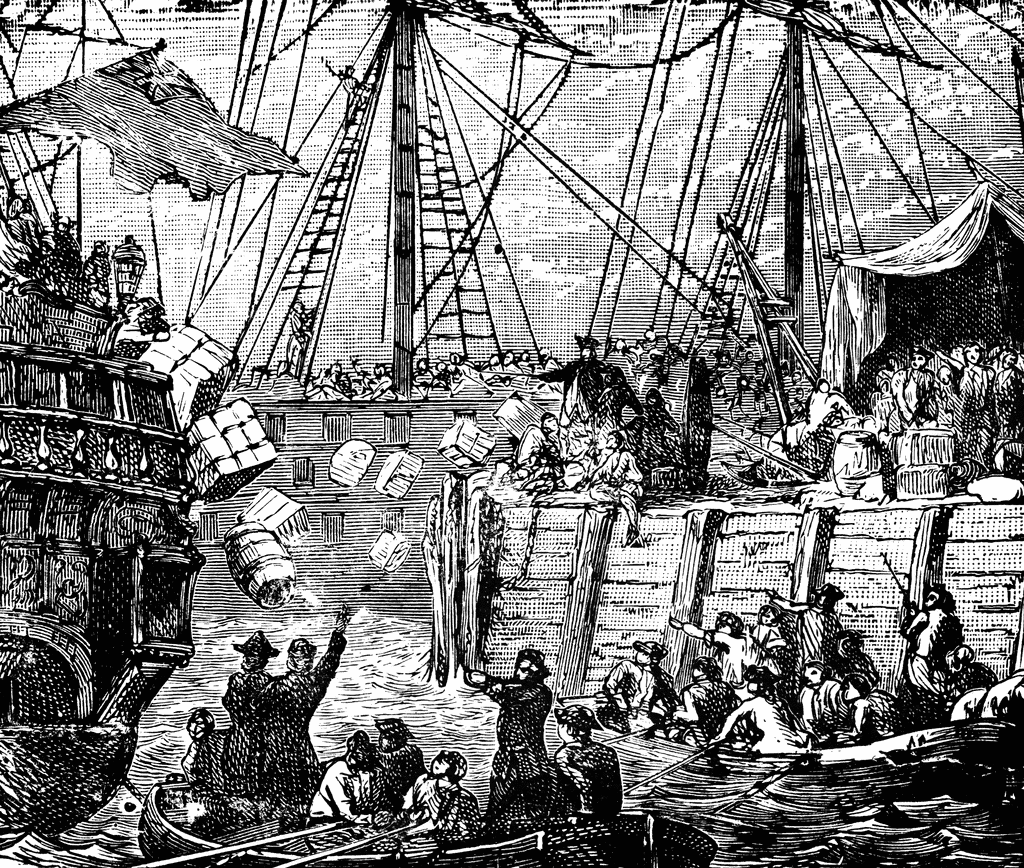
Source: Charlotte M. Yonge Young Folks' History of England (Boston: D. Lothrop & Co., 1879)
CONCLUSION
Shapiro and its progeny reveal the danger of misapplying unbounded common-law principles to a statutory scheme that needs neither supplementation nor gap-filling to protect intellectual property. The Copyright Act has existed since 1790, and never in its six iterations has it mentioned vicarious or contributory liability. One must be wary when a lone circuit court in 1963, with one fell swoop, creates a new category of copyright liability.
If vicarious and contributory liability are here to stay, each element must be addressed rigorously and exclusively. The “right and ability to control” the infringer's act cannot be inferred from boilerplate contract language. “Financial benefit” must stem from the infringing goods themselves, not from a flat rate received from infringers and non-infringers alike. “Knowledge” must mean awareness of repeat infringing sellers, rather than past sellers who may never be seen again. “Material contribution” must mean promoting and sustaining infringing activities, not merely providing a site on which some infringing activity may occur. Gutting these elements of their meaning threatens many traditional American marketplaces by imposing impracticable requirements. It also gives copyright holders a windfall by allowing them to manufacture liability with insufficient evidence. At its core, this suit has nothing to do with copyright infringement. It is an attempt to pass the cost of protecting one's copyright to middlemen and, ultimately, to consumers.
Sony is understandably concerned with the unauthorized sale and distribution of copyrighted music. They are welcome to hire full-time investigators at Cole's flea market to increase enforcement of their copyrights. What they may not do is hold Cole liable for illicit sales by third-party, unsupervised vendors-from whom he profits indirectly, if at all-simply because the sales occurred on his land.
Sony will take nothing from Cole.
Them's fightin' words - EFF will be loving this decision. Only in Texas can you ignore those damned lawyer letters and not risk your ranch.
Tuesday, September 9, 2008
Direct Infringement and Digital Video Recorders: Catch as Cache Can
 Cartoon Network LP v. CSC Holdings, Inc., --- F.3d ---, 2008 WL 252614 (August 4, 2008). Instead of taking a satellite signal and broadcasting it straight into your home at the time dictated by the broadcaster, your local cable company sets up a very fancy digital box (Digital Video Recorder or “DVR”). A DVR permits you to use your remote control, point it at the television, and program that digital box to copy a future broadcast. When the broadcast comes in, the digital box copies the broadcast for you. When you want to view the broadcast at a different time, you and your family can access the copy on the digital box.
Most of us think of a DVR as something we buy, put underneath the television, puff out our chests and think “fair use” as we make a personal use copy.
But what if the box is miles away from your home, is owned by your local cable company, and is a massive computer monster that invites everyone to make copies from it. Has the cable company made a copy? Or did you make a copy? And if you play your copy by hitting the remote and putting the copy in the digital box in motion, did you infringe?
Well, one would have guessed that the cable company had engaged in copyright infringement, one way or another. And that’s what the local district court found. But on appeal, in an August 4, 2008 decision that will make happy those who really dig the technological questions involved in litigation over devices that make copies, the Second Circuit Court of Appeals reversed.
Why? Well, most of us acting as a plaintiff who owned a copyright would have alleged that the cable company had engaged in both direct copying and indirect or contributory infringement. Really, that DVR seems like a very Napster-like infringing mechanism that permits people who pay the cable company to make infringing copies and for the cable companies to profit.
But in a very thoughtful decision that really delves into the technology involved and the legislative history involved, the Second Circuit really digs into the question of what constitutes a copy, what is necessary for fixation of the copy and how much time a copy must exist to be a copy, with a very thorough survey of the law related to various ephemeral copies, such as a copy of a program made that boots up into your computer’s RAM. The Second Circuit found that “fixation” of the copy imposes both an “embodiment” requirement and a “duration” requirement. The Second Circuit found that the machine’s buffering system, which made a copy of .1 seconds of each channel’s programming at any one time and such content did not last for more than 1.2 seconds. The Court found that the plaintiff’s copyrighted material was not “fixed” in the buffers for an amount of time sufficient to satisfy the "duration" aspect of fixation and therefore that the buffers did not make an infringing copy.
The most interesting part of the decision discusses the question of whether or not the cable company is directly liable for creating the copies. And in a discussion of copy shop cases and the Supreme Court’s Sony v. Universal Films case, the Second Circuit emphasized that the U.S. Supreme Court and the Copyright Act really make a distinction between direct copying and contributory liability for someone who actively induces an infringement.
So the court found that it is the actual consumer who makes the copy by pre-programming the digital box to capture the incoming broadcast for later use. In the case, the plaintiffs for some reason did not allege that the cable company engaged in contributory infringement, so the lower court’s decision was reversed. The Second Circuit explicitly kept open the question of whether the cable company was liable as a contributory infringer.
On the issue of whether playing the new copy at a different time by the consumer constituted a “performance” which required a license from the plaintiff copyright owners, the court’s answer was “no”.
This is an important, difficult and complex case, and worth reading. It is likely to be influential in litigations involving services that make potentially copyrighted materials available to consumers.
Saturday, September 6, 2008
Creative Commons, Open Source, Copyright and Contract Law

For a number of years, activists dismayed at how commercial enterprises exploited copyright agitated to change the nature of how copyrighted works affected creative collaboration. They imagined a world of greater creative collaboration where everyone would still be able to make a living.
Authors, artists and musicians who wished to have their works used in others' materials could signify their interest.
Information and tools to understand this movement, including the "creative commons" marking and sample licenses are available at the Creative Commons website.
Wikipedia is a stunning example of this type of creative collaboration.
But what about the making money part? If you put your work on the internet and tell everyone that they can use it, are these very creative "creative commons" licenses going to eventually help you make a living? Can these licenses be enforced? And if someone ventures beyond the terms of the license, is that a breach of contract or is it copyright infringement?
The issue went from an interesting and hotly debated academic question to a tremendous commercial reality with the advent of the "open source" software movement, which adopted a creative commons-type license. Essentially, software programmers put up programming code that anyone can download, modify, use and distribute for free, as long as the "borrowed" or "open source" code is clearly indicated and enabled for the distributee to copy, download and use.
On August 13, 2008, the Court of Appeals for the Federal Circuit decided Jacobsen v. Katzer, 2008 WL 3395772, a decision that reviewed a district court's denial of a preliminary injunction to the owner of programming code who sued a person who downloaded his code, removed the identifying materials, and sold a new software package commercially.
The district court found that the open source license was an intentionally broad non-exclusive license unlimited in scope. Rather than being a matter of "copyright infringement", the issue became one of "breach of contract". The district court's holding meant that the owner of the open source code would be stripped of powerful rights and remedies available in federal court to copyright owners who are victims of copyright infringement, including the right to injunctive relief.
Generally, a copyright owner who grants a nonexclusive license to use copyrighted materials waives the right to sue the licensee for copyright infringement. But where a license is limited in scope and the licensee acts outside the scope, the licensor can sue for copyright infringement.
The Court of Appeals framed the issue as follows: if, under California law the terms of the open source license were "conditions" for the use of the copyrighted materials, then use outside such conditions would be copyright infringement. If, however, the terms of the open source license were "covenants" under state contract law, then the open source owner would be limited to remedies for breach of contract.
Analyzing the terms of the open source license, the Court of Appeals found that its provisions were "enforceable copyright conditions" for the use of the copyrighted material and that copyright remedies would be available to the owner.
The Court of Appeals decision contains an excellent discussion of the commercial benefits flowing from open source collaboration that cannot be measured in terms of traditional royalties. This is a well-reasoned opinion that is a strong victory for the owners of these copyrighted works. According to Creative Commons, it is estimated that approximately 100,000,000 works are licensed under various Creative Commons licenses. The court noted that both Creative Commons and the Wikimedia Foundation filed friend of the court (amicus curiae) briefs in support of the appeal.
While the question of how or if many of these copyright owners will seek or achieve returns on their investments is an open one, this case is a clear victory for the rights of copyright owners who want to make their works available through the digital commons.
Friday, August 29, 2008
User-Generated Video Uploads Veoh, Napster, Google and Safe Harbors

In Io Group, Inc. v. Veoh Networks, Inc., No. C06-03926 (HRL), a decision dated August 27, 2008 by Northern District of California Judge Harold Lloyd, discussed by PC Magazine here, the court found that the video uploading service found at http://www.veoh.com/ is not liable for copyright infringement.
The Veoh website permits users to view and upload their own videos and to share revenues generated from advertising revenues with Veoh. Veoh automates the process, so Veoh is not engaged in reviewing content before it goes up. You can also watch television shows made available by Veoh's "content partners". I note such shows as CSI and Ugly Betty from Veoh's home page.
The plaintiff sued Veoh claiming that its copyrighted films were posted on Veoh without bothering to give Veoh notice beforehand.
The decision has a great discussion of the technology involved in the uploading and storing process. It also has a thorough discussion of Veoh's user policies and the legislative history relative to the Digital Millenium Copyright Act that provides a "safe harbor" to online service providers who take reasonable measures to ensure that they are not helping copyright infringers. There is an informative discussion of why Veoh's case differs from the facts of Napster, although the underlying facts of Napster were not fully fleshed out. In today's New York Post, the Veoh case was reported as "Copyright case may aid Google".
Judge Lloyd found Veoh's policy to be reasonable, and rejected arguments that a stronger policy which would be more effective in barring people from creating new false user names was mandated as a condition for avoiding copyright infringement liability. He rejected the argument that the possibility of a banned user creating new false user names amounted to no policy at all. He also made clear that the law was designed to permit different approaches to developing an anti-infringement policy.
Certainly, this flexible approach has to be encouraging to Google, whose policies were not 100% effective against people who actively sought to foil them.
Subscribe to:
Posts (Atom)