Showing posts with label vicarious infringement. Show all posts

Monday, April 11, 2011

Statutory Damages Under The Copyright Act - Lessons From LimeWire


Arista Records - Throwing a Funeral Party Over Lime Wire?

Arista Records LLC et a. v. Lime Group LLC (Lime Wire) (06 CV 5936) has recently spawned a series of decisions of interest for those who follow the Copyright Act's provisions on statutory damages.   More posts on statutory damages here.

Right now the First Circuit is deciding the Tenenbaum case which includes a challenge to an award of statutory damages against a student downloader.  More on Tenenbaum here and here.

But in the Lime Wire case (background here), Judge Kimba Wood granted summary judgment on May 11, 2010 finding Lime Wire liable as a secondary infringer for running a service that facilitates peer-to-peer file sharing, full decision here.   An interesting aspect of the case is that Lime Wire's founder was held to be personally liable.

But following Judge Wood's grant of summary judgment, a recent flurry of decisions relating to the Copyright Act's statutory damages provisions, 17 USC 504(c) have emerged.

In Chapter 17 of Copyright Litigation Handbook (West 2010), I cover issues relating to damages under the Copyright Act.   Chapter 18 covers the related issues of costs and attorneys fees.

On March 10, 2011, Judge Wood considered the issue of whether Lime Wire, a secondary infringer, was liable for multiple awards of statutory damages for each copyrighted work it permitted to be infringed, or only one.   Analyzing the provisions of 17 USC 504(c) and its legislative history, Judge Wood found that the record companies could only recover from Lime Wire one statutory damages award for each copyrighted work infringed.   The decision is worth the read, find it here.

But how does one prove ownership and infringement of 11,000 plus works?  And how do you prove that each owner owned it at the time the work was infringed?   Judge Wood's decision of March 29, 2011 is here.   Review each category, and you have a neat primer on how to prove copyright ownership in a variety of contexts.   A unique angle is that Plaintiffs hired private investigators in 2010 to illegally download one of each of the works.   Defendants challenged the "timing" of ownership.   Judge Wood granted summary judgment on ownership, since that was essentially unchallenged by the evidence.

Practice Tip:   Judge Wood points to the Second Circuit's case law showing that if a litigant challenges evidence submitted on a summary judgment motion, the proper remedy is a motion to strike the evidence.

On April 4, 2011, Judge Wood looked at the question of whether a statutory damages award was available for each song, or for each sound recording (an album is one sound recording and ordinarily supports only one statutory damages award).   Judge Wood's decision here.    Judge Wood ruled that if infringements of individual songs could be shown prior to release of the album, statutory damages awards would be available for infringements of those individual songs.

On April 6, 2011, Judge Wood considered the question of whether Lime Wire was "off the hook" as a secondary infringer where the record companies had already obtained judgments against primary infringers.  Judge Wood's answer: "no".   The damages trial is scheduled for May 2, 2011.

The April 6, 2011 decision below:

Lime Wire Partial Summary Judgment April 6, 2011


http://www.dunnington.com/rdowd_bio.html
 Purchase Copyright Litigation Handbook 2010 by Raymond J. Dowd from West here  

Sunday, April 11, 2010

Judge Throws Copyright Law Tea Party: "Impolite" Flea Market Vendor Not Liable for Contributory Copyright Infringment

A Texas judge queries whether contributory or vicarious liability under the Copyright Act even exists and slaps Sony so hard it must still be spinning.

Did the Founding Fathers envision we'd all be digital sharecroppers under Shapiro, Bernstein & Co. v. H.L. Green Co., 316 F.2d 304, 307 (2d Cir. 1963)?

                                                      Battle of the Alamo, Percy Moran 1912

From Sony Discos, Inc. v. E.J.C. Family Partnership, 2010 WL 1270342, 4 -5 (S.D.Tex. 2010)


If Cole had been even minimally polite, perhaps this suit would never have been filed, and in hindsight, Cole would probably agree that the cost of the offered training was far less than that of litigation. His arguably bad choices are not, however, willful blindness.


A flea market owner does not have the duty to police his vendors, or enforce the producers' copyrights. Clearly, if Cole induced or caused a sale of infringing music, he would be liable. If Cole knew of a particular infringing sale-at the time of the sale-and chose to ignore it, he might be liable. His assertion that he didn't have time to do it and his refusal to consider alternatives does not mean Cole was willfully blind to the vendors' infringing activities. He was not indifferent. On the contrary, he cared very much about the extra work he would have to do to enforce Sony's copyrights.

The essential trade in the Copyright Act is monopoly and policing: the grant of exclusivity comes with the duty to protect it. The Act does not grant the holder the windfall of both monopoly and reimbursement for its maintenance.

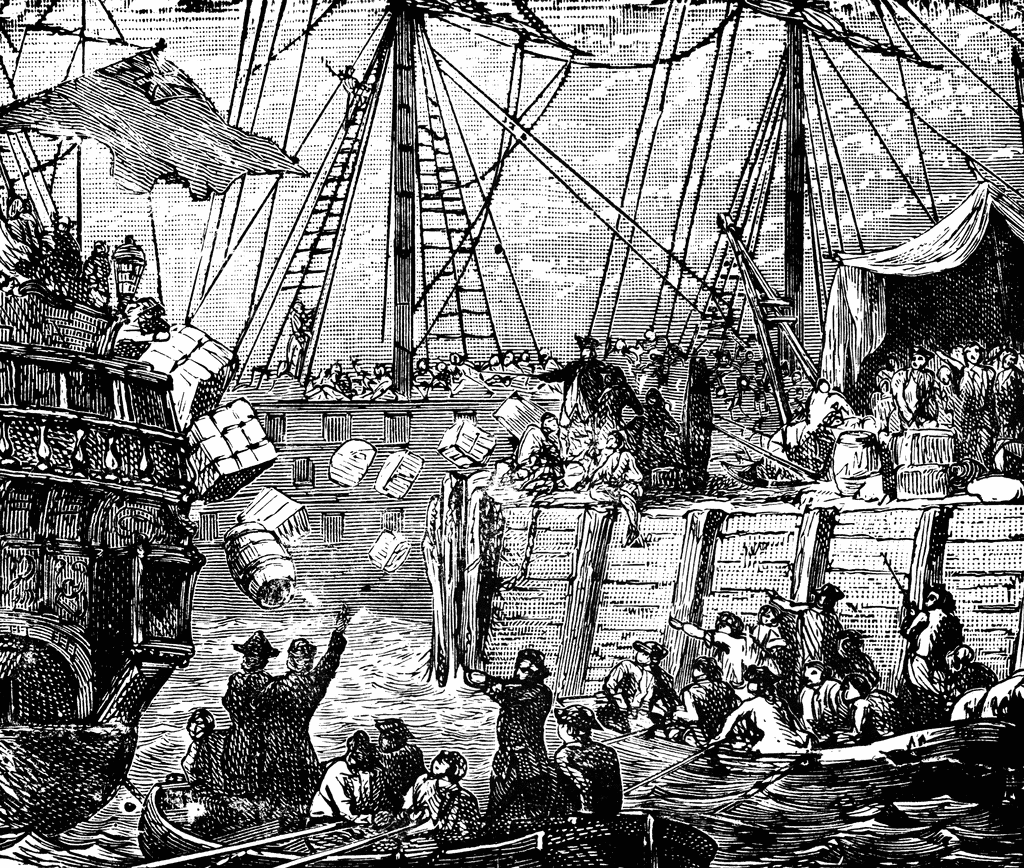
Description: The Boston Tea Party, protesting the English tax on tea.


Source: Charlotte M. Yonge Young Folks' History of England (Boston: D. Lothrop & Co., 1879)

CONCLUSION

Shapiro and its progeny reveal the danger of misapplying unbounded common-law principles to a statutory scheme that needs neither supplementation nor gap-filling to protect intellectual property. The Copyright Act has existed since 1790, and never in its six iterations has it mentioned vicarious or contributory liability. One must be wary when a lone circuit court in 1963, with one fell swoop, creates a new category of copyright liability.


If vicarious and contributory liability are here to stay, each element must be addressed rigorously and exclusively. The “right and ability to control” the infringer's act cannot be inferred from boilerplate contract language. “Financial benefit” must stem from the infringing goods themselves, not from a flat rate received from infringers and non-infringers alike. “Knowledge” must mean awareness of repeat infringing sellers, rather than past sellers who may never be seen again. “Material contribution” must mean promoting and sustaining infringing activities, not merely providing a site on which some infringing activity may occur. Gutting these elements of their meaning threatens many traditional American marketplaces by imposing impracticable requirements. It also gives copyright holders a windfall by allowing them to manufacture liability with insufficient evidence. At its core, this suit has nothing to do with copyright infringement. It is an attempt to pass the cost of protecting one's copyright to middlemen and, ultimately, to consumers.

Sony is understandably concerned with the unauthorized sale and distribution of copyrighted music. They are welcome to hire full-time investigators at Cole's flea market to increase enforcement of their copyrights. What they may not do is hold Cole liable for illicit sales by third-party, unsupervised vendors-from whom he profits indirectly, if at all-simply because the sales occurred on his land.

Sony will take nothing from Cole.

Them's fightin' words - EFF will be loving this decision.  Only in Texas can you ignore those damned lawyer letters and not risk your ranch.